Facts checked Article
Process notes
Withdrawal clocks: the operator's clock, the bank's clock, and what the terms say
A withdrawal has at least two clocks, and an identity check sits in front of both. Licence condition 17.1.1 and Pay.UK's own scheme page settle which clock may start when.
Withdrawal clocks: which one is actually running
Withdrawal clocks run in sequence rather than together. The operator's processing time and the payment rail's transit time are separate stages, and a published window usually covers only one of them.
A third clock sits in front of both. If an identity check has not been completed, neither the operator's clock nor the rail's has started.
The rail is the bank or scheme that moves the money once the operator releases it. Pay.UK states that its Faster Payment System is ‘available day and night, 365 days per year’ and carries ‘real-time payments of up to £1m’.
We tested no operator and timed no payment for this page. What follows is a ledger format for withdrawal clocks, and the two published rules that decide when each one may start.
Sources: LCCP condition 17.1.1; Gambling Commission: age and ID verification; Pay.UK: Faster Payment System.
The published rules behind each stage
- What must happen before a customer gambles
- Licence condition 17.1.1: licensees ‘must obtain and verify information in order to establish the identity of a customer before that customer is permitted to gamble’, including ‘the customer’s name, address and date of birth’.LCCP condition 17.1.1 · as checked on
- What may not be asked at withdrawal
- Licence condition 17.1.1: a withdrawal request ‘must not result in a requirement for additional information to be supplied as a condition of withdrawal if the licensee could have reasonably requested that information earlier’.LCCP condition 17.1.1 · as checked on
- Whether a timescale is published for identity checks
- The Commission’s guide states: ‘We cannot provide a timescale for ID checks as the length of the process varies.’Gambling Commission: age and ID verification · as checked on
- What one payment rail can do
- Pay.UK states that the Faster Payment System is ‘available day and night, 365 days per year’ and carries ‘real-time payments of up to £1m’.Pay.UK: Faster Payment System · as checked on
- What the guide says about a delay over documents
- Where a business delays withdrawal requests because it did not ask earlier, the guide says it ‘may be in breach of Licence Condition 17’; a customer should ‘contact the company directly’ and ‘follow the complaints process’.Gambling Commission: age and ID verification · as checked on
Quoted from the three pages we read on 22 September 2026. No operator's help page or terms were read, so no processing window is published here.
Stage 1 — request: what to record before you press confirm
Record five things at the moment of the request. The date and time, the amount, the payment method, the reference the operator supplies, and the wording of the terms that describe processing times.
Keep a copy of that wording rather than a summary of it. A processing estimate is only useful when it states what starts the clock and whether it counts calendar days or working days.
An estimate with no starting event is not a window. It is a number with nothing attached to it, and it cannot be checked later against what actually happened.
The checklist below is the record we would keep. Nothing on this page is saved or sent anywhere, and we fetch no operator's performance data.
Sources: Gambling Commission: age and ID verification.
The five lines to write at the moment of the request
Ticks are kept only in this browser and are never sent anywhere.
Stage 2 — identity: the check that belongs before the withdrawal
An identity check is meant to happen before a customer gambles, not when they ask for their money.
Licence condition 17.1.1 states that licensees ‘must obtain and verify information in order to establish the identity of a customer before that customer is permitted to gamble’. The same paragraph requires that information to include the customer's name, address and date of birth.
The second paragraph of the same condition covers withdrawals. A withdrawal request ‘must not result in a requirement for additional information to be supplied as a condition of withdrawal if the licensee could have reasonably requested that information earlier’.
The Commission's player guide puts the same rule in plainer words, read 22 September 2026. A gambling business ‘can't ask you to prove your age and identity as a condition of withdrawing your money if they could have asked you at an earlier point’.
Sources: LCCP condition 17.1.1; Gambling Commission: age and ID verification.
The withdrawal paragraph of licence condition 17.1.1
A request made by a customer to withdraw funds from their account must not result in a requirement for additional information to be supplied as a condition of withdrawal if the licensee could have reasonably requested that information earlier.
Stage 3 — processing: the operator's own clock
Processing is the operator's stage, and its length comes from the operator's published terms. We read no operator's terms for this page, so we publish no processing figure here.
What the regulator does say is that the identity stage has no published timescale. Its guide states: ‘We cannot provide a timescale for ID checks as the length of the process varies.’
That sentence is worth keeping. It means a delay at the identity stage cannot be measured against any published number, so the record you keep becomes the only chronology there is.
For what each operator publishes, the companion ledger tabulates it method by method. This page stays on the narrower question of which withdrawal clocks a published window actually covers.
Sources: Gambling Commission: age and ID verification.
The ledger stages, and whose clock each one is
Requested
You confirm the withdrawal and the operator issues a reference.
Typical Recorded by you at the time
Identity checked
Name, address and date of birth are checked, which the LCCP requires before a customer is permitted to gamble.
Typical No published timescaleLongest seen Not published
Gambling Commission: age and ID verification · as checked on
Processed by the operator
The operator completes its own handling of the request.
Typical From the operator's own termsLongest seen Not established here
LCCP condition 17.1.1 · as checked on
Released to the rail
The operator hands the payment to the bank or scheme. Its clock ends here and the rail's begins.
Typical Set by the operator's release
Received
The money arrives in the account you named.
Typical The Faster Payment System is available day and night, 365 days per year
Pay.UK: Faster Payment System · as checked on
Stage names are this site's ledger format. Only the identity and rail rows carry a published figure; the others are recorded by the customer or set by an operator's own terms.
Stage 4 — the rail: the bank's separate clock
The rail only starts once the operator releases the payment. Before that moment, nothing about the bank's speed is relevant to the wait.
Pay.UK, which runs the Faster Payment System, states that it is ‘available day and night, 365 days per year’ and supports ‘real-time payments of up to £1m’. It also states that participants ‘connect safely and securely either directly, or indirectly’ to the central infrastructure, and that the service reaches ‘virtually everyone with a bank account’.
Those are facts about one rail. They are not a claim about which rail any operator uses, and we did not test that.
They still have one practical use. Where a wait is counted in working days, a scheme that runs every day of the year is not the obvious explanation, and the record you kept is what shows where the time went.
Sources: Pay.UK: Faster Payment System.
Why one withdrawal time hides two clocks
A single figure cannot answer the question a reader actually has about withdrawal clocks, which is where the time is going. The table below separates the stages and records, for each one, whose clock it is and what a published source settles.
Two rows are settled by a published rule. The identity row is governed by licence condition 17.1.1, which requires verification before gambling and forbids a new document request at withdrawal that could reasonably have been made earlier.
The rail row is settled by Pay.UK's own description of the Faster Payment System. Two further rows are not settled at all, because the request and the receipt are recorded by you and no published source records them.
One row we deliberately leave open. The operator's processing stage varies by operator and by method, and we read no operator's terms for this page.
Sources: LCCP condition 17.1.1; Pay.UK: Faster Payment System; Gambling Commission: age and ID verification.
Five stages, five clocks
| Stage | Whose clock | What starts it | What a published source settles | Evidence |
|---|---|---|---|---|
| Requested | Yours | You confirm the withdrawal | Nothing published: you record the date, time, amount, method and reference | · Gambling Commission: age and ID verification |
| Identity check | The operator's | Account opening, or any earlier point the operator could reasonably have asked | Licence condition 17.1.1: verification before gambling, and no new request at withdrawal that could have been made earlier | · LCCP condition 17.1.1 |
| Processing | The operator's | The operator's own published terms | Not established here: we read no operator's terms | · LCCP condition 17.1.1 |
| The rail | The bank or scheme's | The operator releasing the payment | Pay.UK: the Faster Payment System is available day and night, 365 days per year, for payments of up to £1m | · Pay.UK: Faster Payment System |
| Received | Yours | The money arriving in the account you named | Nothing published: you record the date and time | · Gambling Commission: age and ID verification |
How to build a record of the withdrawal clocks
The record is a table with one row per stage and one date per row. It takes a minute at the time, and it saves an argument later.
Keep the operator's own wording beside each date. A paraphrase of a term is not evidence of what that term said on the day you read it.
Do not send identity documents to any address other than the operator's published upload route. If a message asks for documents through another channel, treat the channel itself as the thing to check first.
Sources: Gambling Commission: age and ID verification.
Six lines, in the order they happen
The result is a chronology, not a complaint. It becomes useful only when the published window has passed and you need to show when each stage began.
Record the request
Write the date, the time, the amount, the payment method and the reference the operator issued.
Copy the terms
Paste the operator's processing wording into the record, with the date you read it.
Note what starts the clock
Record whether the window counts calendar days or working days, and which event begins the count.
Log every exchange
Save confirmation messages and the date of each support reply, including what was asked for and what you sent.
Mark the release
Record the moment the operator says the payment was released, because that is where its clock ends and the rail's begins.
Compare, then escalate if you need to
Set the elapsed time against the wording you copied. If the published window has passed, the operator's own complaints process is the first route.
Send documents only through the operator's published upload route.
When the window passes: the complaints route
Start with the operator. The Commission's guide says that a customer who is unhappy with the information requested should ‘contact the company directly’ and follow the complaints process that the business publishes.
The same guide records what can follow. Where a business delays withdrawal requests because identity information was not collected earlier, the guide says that business ‘may be in breach of Licence Condition 17’ and may face regulatory action.
A delay is not evidence of bad faith, and this page does not treat it as such. It is a gap in a chronology, and the record you kept is what fills it.
If a delayed withdrawal is tempting you to keep playing with the balance instead, that is a known pattern. GamCare is on 0808 8020 133, free, 24 hours.
What these pages do not settle
Three things about withdrawal clocks stay open after reading all three sources, and none of them can be filled by inference.
The first is how long any named operator takes to process a withdrawal, because we read no operator's terms. The second is which payment rail a given operator uses.
The third is how long an identity check takes, because the Commission states that it cannot provide a timescale. A label such as instant describes a scheme's capability, not a promise about your payment.
Next step: start the record above at the moment you press confirm. Was this useful, or did we get something wrong? Tell us and we will correct it.
Sources: Gambling Commission: age and ID verification; Pay.UK: Faster Payment System.
Six words used on this page
- The rail
- The bank or payment scheme that moves money once the operator has released it.
- Working days
- Days on which banks are open, which excludes weekends and public holidays, so a window counted this way runs longer than the same number of calendar days.
- Identity check
- Verification of a customer's name, address and date of birth, which licence condition 17.1.1 requires before that customer is permitted to gamble.
- Faster Payment System
- A UK payment scheme run by Pay.UK, which states that it is available day and night, 365 days per year, for real-time payments of up to £1m.
- LCCP
- The Licence Conditions and Codes of Practice, the rulebook the Gambling Commission attaches to every operating licence.
- Licence condition
- A binding rule inside the LCCP that an operator must follow to keep its operating licence.
Pages read 22 September 2026
Three pages were opened on 22 September 2026: the Gambling Commission's age and identity verification guide, licence condition 17.1.1 in the LCCP and Pay.UK's Faster Payment System page.
No operator's help page or terms were read for this revision, so no operator is named, compared or ranked. We did not measure a withdrawal, and we did not deposit, stake or withdraw anything.
Every figure quoted above belongs to the source beside it. Re-check dates are set two months out, because a licence condition and a scheme description both change on their own timetable.
Sources: Gambling Commission: age and ID verification; LCCP condition 17.1.1; Pay.UK: Faster Payment System.
Pages read
Each page was opened on 22 September 2026.
| Source | Publisher | Read on | Re-check due | Note |
|---|---|---|---|---|
| LCCP condition 17.1.1 | Gambling Commission | Paragraphs 1 and 2 of the condition: verification before gambling, and no new information required at withdrawal. | ||
| Gambling Commission: age and ID verification | Gambling Commission | The plain-English version of the withdrawal rule, the absence of a published ID timescale, and the complaints route. | ||
| Pay.UK: Faster Payment System | Pay.UK | Availability day and night, 365 days per year; real-time payments of up to £1m; direct and indirect participation. |
Questions answered
How many clocks does a withdrawal have?
At least two, and usually three. The operator's processing time and the payment rail's transit time are separate stages, and an identity check sits in front of both: until it is complete, neither of the other clocks has started.
Can an operator ask for documents only when I withdraw?
Licence condition 17.1.1 states that a withdrawal request ‘must not result in a requirement for additional information to be supplied as a condition of withdrawal if the licensee could have reasonably requested that information earlier’.
How long should an identity check take?
No figure is published. The Gambling Commission's guide states: ‘We cannot provide a timescale for ID checks as the length of the process varies.’ That is why the dates you record yourself are the only chronology of the stage.
Is the bank the slow part?
We did not test that and we name no operator. Pay.UK states that the Faster Payment System is available day and night, 365 days per year, for payments of up to £1m, but that is a fact about one scheme and not about any operator's release time.
What should I do when the published window passes?
The Commission's guide says to contact the company directly and follow its complaints process. It also records that a business delaying withdrawals over information it could have requested earlier ‘may be in breach of Licence Condition 17’.
What does this page not tell me?
It gives no processing figure for any named operator, because we read no operator's terms. It does not say which rail an operator uses, and it does not predict when your money will arrive.
Payment sources
Continue reading
Build a complaint record for a delayed casino withdrawal
The withdrawal request and the complaint start different clocks. Keep the payment evidence, the operator’s response and the escalation record together without assuming what caused the delay.
Read Build a complaint record for a delayed casino withdrawal
Identity checks and withdrawals: the condition, the guidance and the scope
An identity check belongs at registration, not at the cashier. Licence condition 17.1.1 puts name, address and date of birth before any gambling, and says a withdrawal request must not trigger information that could reasonably have been asked for earlier.
Read Identity checks and withdrawals: the condition, the guidance and the scope
An identity check and a source-of-funds request answer different questions
A passport can establish identity without explaining a transfer. Sort a casino document request by the question it asks, then keep a receipt for the evidence supplied.
Read An identity check and a source-of-funds request answer different questions
How long do casino withdrawals take? What ten UK operators publish, and which clock each window measures
Ten UK operators’ published withdrawal windows by payment method, quoted from their help pages on 18 September 2026, with the operator’s processing clock separated from the bank’s.
Read How long do casino withdrawals take? What ten UK operators publish, and which clock each window measures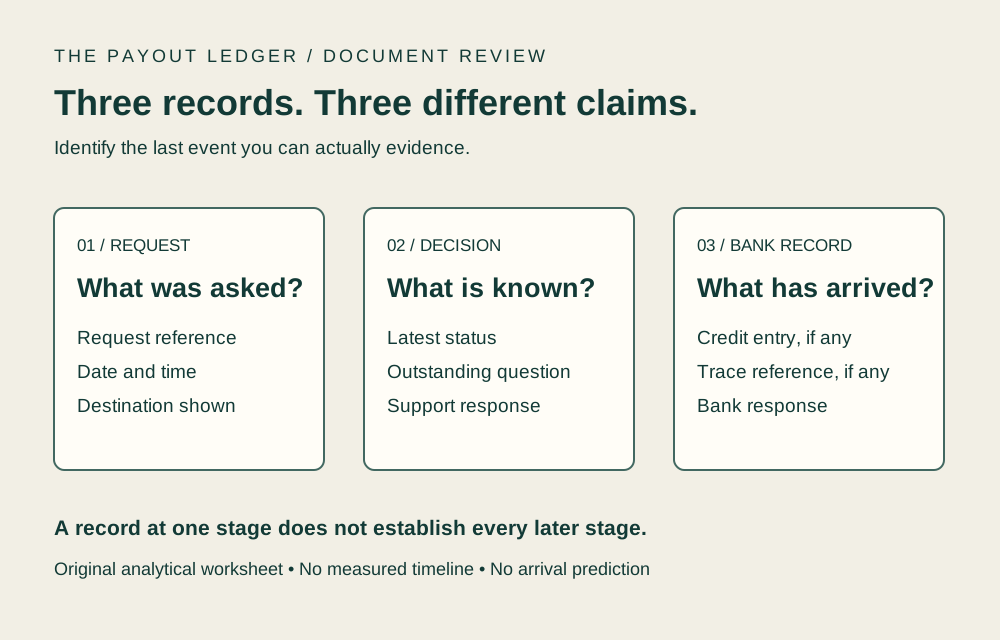
How do William Hill card withdrawals work? A document review
How to read William Hill’s card-withdrawal documents: payment routing, pending and approved requests, Visa Direct conditions and bank tracing.
Inspect How do William Hill card withdrawals work? A document review
Continue reading
Build a complaint record for a delayed casino withdrawal
The withdrawal request and the complaint start different clocks. Keep the payment evidence, the operator’s response and the escalation record together without assuming what caused the delay.
Read Build a complaint record for a delayed casino withdrawalAn identity check and a source-of-funds request answer different questions
A passport can establish identity without explaining a transfer. Sort a casino document request by the question it asks, then keep a receipt for the evidence supplied.
Read An identity check and a source-of-funds request answer different questionsIdentity checks and withdrawals: the condition, the guidance and the scope
An identity check belongs at registration, not at the cashier. Licence condition 17.1.1 puts name, address and date of birth before any gambling, and says a withdrawal request must not trigger information that could reasonably have been asked for earlier.
Read Identity checks and withdrawals: the condition, the guidance and the scopeIdentity checks and withdrawals: the condition, the guidance and the scope
Build a complaint record for a delayed casino withdrawal
An identity check and a source-of-funds request answer different questions
How do William Hill card withdrawals work? A document review