Facts checked Article
Great Britain
An identity check and a source-of-funds request answer different questions
A passport can establish identity without explaining a transfer. Sort a casino document request by the question it asks, then keep a receipt for the evidence supplied.
Put the question beside the requested document
An identity check asks who the customer is. A source-of-funds request asks where money came from. Those questions can arise in the same online-casino account, but satisfying one does not necessarily answer the other.
A passport does not show the origin of a bank transfer; a transfer entry does not, by itself, establish every identity detail.
The Gambling Commission's public guidance distinguishes age and identity verification from later requests concerning finances. Its customer-identity condition requires identity information to be obtained and verified before a covered customer can gamble. It also restricts demands triggered by withdrawal where the information could reasonably have been requested earlier, while preserving requests needed at that time for another legal obligation.
This ledger is for understanding and recording a request in Great Britain. It supplies no universal upload pack, acceptance deadline or judgement about an individual case. No account was opened, documents submitted or withdrawal tested.
We read the public sources on 19 September 2026 and built the example below from invented details.
Sources: Age, ID and financial verification; 17.1.1 – Customer identity verification.
Ledger heading — the question each request asks
- Identity check
- Asks who the customer is. The Commission's customer-identity condition requires identity information to be obtained and verified before a covered customer can gamble.17.1.1 – Customer identity verification · as checked on
- Source-of-funds request
- Asks where money came from. A passport does not show the origin of a bank transfer; a transfer entry does not, by itself, establish every identity detail.Age, ID and financial verification · as checked on
- The timing rule
- Condition 17.1.1 restricts demands triggered by withdrawal where the information could reasonably have been requested earlier, while preserving requests needed at that time for another legal obligation.17.1.1 – Customer identity verification · as checked on
- No universal pack, no universal stopwatch
- The Commission lists passports, driving licences and household bills as examples but does not prescribe one list for every customer, and it says it cannot provide a single ID-check timescale because processes vary.Age, ID and financial verification · as checked on
- What this ledger is
- A private note structure for understanding and recording a request in Great Britain. It supplies no universal upload pack, acceptance deadline or judgement about an individual case.Age, ID and financial verification · as checked on
Public sources read on 19 September 2026. No account was opened, documents submitted or withdrawal tested; the example on this page uses invented details.
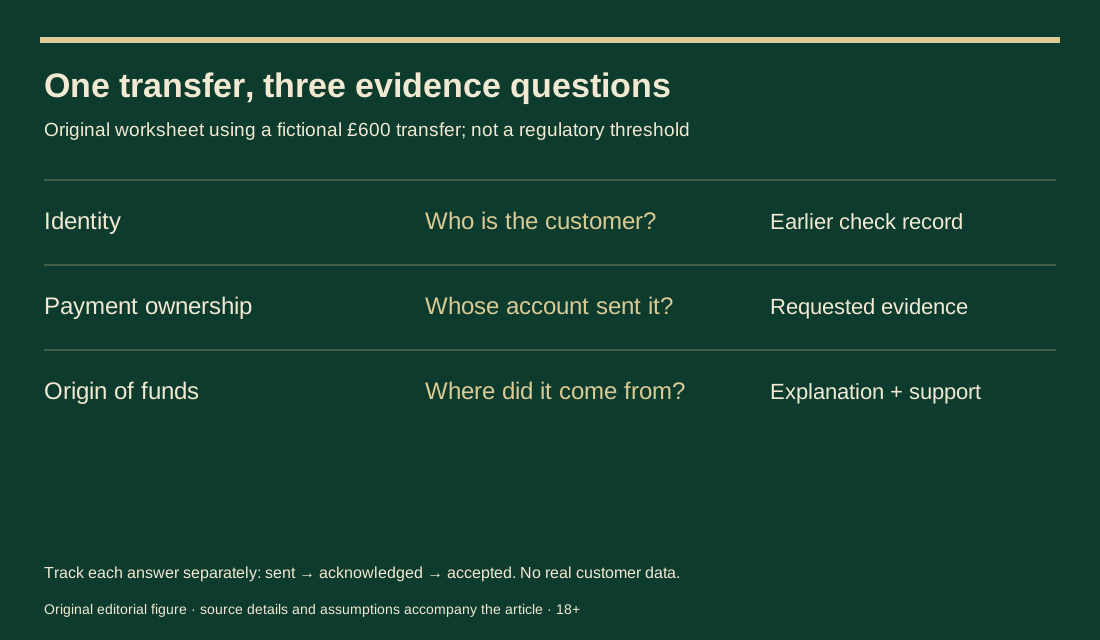
Three columns prevent three different gaps being confused
Start a record with three possible purposes: identity, payment ownership and origin of money. These are editorial worksheet headings, not a claim that every operator uses the same workflow. Keep the operator's own wording next to whichever heading seems relevant, and leave the classification open if the request does not explain itself.
Identity concerns details such as name, address and date of birth. Payment ownership concerns the link between the person and the payment instrument or account. Origin concerns the explanation and evidence for the money entering that account.
One document may help with more than one column, but the columns are not interchangeable.
The Commission lists passports, driving licences and household bills as examples of documents businesses may request. It does not prescribe one list for every customer. Its financial-verification guidance separately identifies bank statements as a way to help check legitimate funds and describes enquiries into income patterns.
The useful first question to support is therefore about purpose: which point does this request need to establish? Asking that is different from refusing every further check because an account once displayed verified. A status label may describe an earlier check without identifying the new question.
Sources: Age, ID and financial verification; 17.1.1 – Customer identity verification.
Work through an invented £600 transfer
Imagine a fictional record with a £600 transfer from a personal bank account to an online casino. The account holder previously supplied identification. A later message requests evidence about the funds.
The amount is an illustration, not a regulatory trigger, a reported customer transaction or a recommended deposit.
In the identity column, record the earlier submission reference and what the operator confirmed. Do not write identity permanently complete: the record establishes only what was acknowledged at that time. In the payment column, note the account the transfer came from and whether ownership evidence has been requested.
In the origin column, copy the precise period or transaction the operator wants explained.
Suppose the £600 followed a transfer from another savings account. The first bank statement might show that immediate transfer without explaining how the savings arose. That is a logical evidence gap, not a conclusion that the money is suspicious or that a particular extra document must be accepted.
Ask what explanation and supporting material the operator requires.
This is the worksheet's contribution: it makes the unanswered question visible without inventing an operator policy. The three columns can have different statuses. An acknowledged identity file does not automatically close a funds-origin enquiry, and a pending enquiry does not prove wrongdoing.
| Purpose | Question | Record to identify |
|---|---|---|
| Identity | Who is the customer? | Earlier check record |
| Payment ownership | Whose account sent it? | Requested evidence |
| Origin of funds | Where did it come from? | Explanation + support |
Stage by stage — fill the three-column worksheet
The invented £600 transfer from the prose, entered column by column. The amount is an illustration, not a regulatory trigger or a recommended deposit.
Identity column — the earlier record
Record the earlier submission reference and what the operator confirmed. Do not write identity permanently complete: the record establishes only what was acknowledged at that time.
Payment column — the sending account
Note the account the transfer came from and whether ownership evidence has been requested.
Origin column — the period to explain
Copy the precise period or transaction the operator wants explained. If the £600 followed a transfer from another savings account, the first statement may show that transfer without explaining how the savings arose; ask what explanation and supporting material the operator requires.
Give each answer three dates
Track each answer separately: sent, acknowledged and accepted for the stated purpose. An acknowledged file is not an accepted file.
What the result means
The three columns can have different statuses. An acknowledged identity file does not automatically close a funds-origin enquiry, and a pending enquiry does not prove wrongdoing.
Do not turn examples into a universal checklist
A public help page's examples are a starting point for a conversation, not a guarantee that any one document will resolve a particular request. The Commission's guidance expressly avoids telling businesses which information types they must request in every case. Its anti-money-laundering condition requires an appropriate business risk assessment and effective policies, procedures and controls.
That leaves an important limit on this article: we cannot infer a standard statement age, upload format or maximum number of documents from those general sources. A claim that every casino must accept the same three files would need authority that we have not found. We make no such claim.
For each actual request, record the period covered, the details needed, the accepted format and the submission route specified by the business. If any field is missing, ask before treating a generic internet checklist as authoritative. Keep both the question and the answer in the same entry so that a later reviewer can see why the file was provided.
Do not upload extra personal material to this publication. The ledger described here is a private note structure, not a document-collection form. It has no scoring system, automated verification or ability to approve an account.
Sources: Age, ID and financial verification; 12.1.1 – Anti-money laundering.
The fields for each actual request
If any field is missing, ask before treating a generic internet checklist as authoritative. Do not upload extra personal material to this publication; the ledger is a private note structure, not a document-collection form.
Ticks are kept only in this browser and are never sent anywhere.
A later request needs a timing explanation
The timing rule is more precise than either casinos can ask for anything at withdrawal or casinos can never ask for another document. Condition 17.1.1 addresses information that could reasonably have been requested earlier and preserves another legal obligation requiring information at the later point. The Commission's consumer guidance also says businesses needing further withdrawal information should ask promptly.
Record when the request arrived, what prompted it according to the business, and whether the same information had already been supplied. If the explanation is simply verification, ask which part remains incomplete. If new circumstances are mentioned, preserve that explanation without converting it into your own legal conclusion.
For the fictional £600 entry, a useful note would distinguish an earlier address check from a later question about a transfer's origin. An unhelpful note would say they already have my passport, so all financial questions are forbidden. The second statement assumes that different documents establish the same thing.
Equally, repeating the words legal obligation does not itself demonstrate that a particular request was timely or appropriate. The evidence ledger records the business's explanation and the unresolved issue. It is not a substitute for the applicable rules or an assessment of the individual circumstances.
Sources: 17.1.1 – Customer identity verification; Age, ID and financial verification.
Timing entry for a later request
Repeating the words legal obligation does not itself demonstrate that a request was timely or appropriate. The entry records the business's explanation and the unresolved issue; it is not an assessment of the individual circumstances.
Ticks are kept only in this browser and are never sent anywhere.
An upload receipt is not an acceptance receipt
Give every submitted item three separate dates if they become available: sent, acknowledged and accepted for the stated purpose. An upload confirmation shows that a system received a file. A support acknowledgement shows that somebody recognised the submission.
Neither necessarily says that the document answered the question.
Use a simple fictional sequence. On day one a file is uploaded. On day two support confirms receipt.
On day three a message says the image is unreadable. That is not three days of completed verification; the acceptance field remains empty. If a replacement is sent, give it its own entry linked to the earlier rejection reason.
The same discipline helps when a file answers one purpose but another remains open. Write address confirmed beside the address request rather than marking the entire account paid. Document review, withdrawal approval and arrival of money are different events.
This worksheet stops at evidence handling and does not estimate the payment rail's arrival time.
Store reference numbers and concise descriptions rather than copying sensitive document contents into an ordinary note. Follow the operator's current submission instructions through its verified account or support route. This article does not validate a message sender or specify redaction rules for a particular business.
Three dates for every submitted item
In the fictional sequence, a file is uploaded on day one, support confirms receipt on day two and a message on day three says the image is unreadable. That is not three days of completed verification: the acceptance field stays empty.
Ticks are kept only in this browser and are never sent anywhere.
There is no universal verification stopwatch
The Commission says it cannot provide a single ID-check timescale because processes vary. Electronic verification may be immediate, while requests for documents may take longer. That guidance does not support a promise that supplying identification will release every withdrawal within a fixed number of hours.
Ask whether a stated estimate begins at upload, receipt of a complete pack or the start of manual review. Then record the answer as the operator's estimate, with its conditions. If the business has not defined the start point, leave the clock unresolved rather than choosing the most favourable interpretation.
In the invented sequence above, an estimate beginning after acceptable documents are received cannot automatically start with the unreadable day-one upload. That is a reading distinction, not permission for an indefinite delay. The record should show both the actual elapsed time and the business's stated starting event.
Avoid comparing two cases from their end dates alone. Different missing information, starting events or statuses can make superficially similar waits incomparable. Our method produces a clearer chronology; it does not measure which operator is faster or guarantee that a request will be accepted.
Sources: Age, ID and financial verification.
Close a request with the answer it actually received
When the operator confirms a point, copy its scope into the final entry: identity details verified, ownership evidence accepted, or funds-origin information reviewed. If the reply uses broader wording, keep the original message rather than narrowing or enlarging it from memory. An unresolved field is a useful finding.
If you still cannot tell what is missing, send a short factual question through the business's support route: which request remains open, which evidence was received and what point still needs answering? The Commission directs customers who are unhappy about requested information to the gambling company.
This article does not decide a complaint or prescribe how its outcome must be reached.
You can stop gambling while an evidence question remains unresolved. Making another deposit or placing another bet is not part of this worksheet. Its purpose is to keep documents, explanations and acknowledgements attached to the correct question, so that a withdrawal discussion does not dissolve into one ambiguous word: verified.
Sources: Age, ID and financial verification.
Words used in this ledger
- Identity check
- The check that asks who the customer is: details such as name, address and date of birth, verified before a covered customer can gamble.
- Source of funds
- The explanation and evidence for where the money entering an account came from; a different question from identity.
- Payment ownership
- The link between the person and the payment instrument or account that sent the money.
- Condition 17.1.1
- The Commission's customer identity verification condition, including its rule on withdrawal-stage demands that could reasonably have been made earlier.
- Payment rail
- The bank or wallet network that carries the money after the operator releases it. Its transit time is a separate clock this worksheet does not estimate.
Questions answered
Why do I need to provide ID?
The Commission identifies age, identity and self-exclusion checks among the reasons. A later financial-information request may address a different question from the initial identity check.
What type of documents can I be asked to provide?
The Commission gives examples including passports, driving licences and household bills, but does not prescribe a universal list. Ask which purpose, period and format the actual request requires.
How long does it take to complete ID checks?
There is no universal Commission timescale. Record whether any operator estimate starts at upload, receipt of complete evidence or review, and keep it separate from payment-transfer time.
Why have I been asked for ID before withdrawing?
Ask the business what remains to be established and why the request arises now. Condition 17.1.1 restricts demands that could reasonably have been made earlier while preserving information needed at that time for another legal obligation.
Does a verified account status mean no more checks can be asked?
No. A status label may describe an earlier check without identifying the new question. Ask which point the new request needs to establish, which is different from refusing every further check.
Is an upload confirmation proof that my document was accepted?
No. An upload confirmation shows that a system received a file and a support acknowledgement shows that somebody recognised it; neither necessarily says the document answered the question. Record sent, acknowledged and accepted separately.
When does an operator's verification estimate start?
Ask whether the stated estimate begins at upload, receipt of a complete pack or the start of manual review, then record the answer as the operator's estimate with its conditions. If the start point is undefined, leave the clock unresolved.
Payment sources
Continue reading
Identity checks and withdrawals: the condition, the guidance and the scope
An identity check belongs at registration, not at the cashier. Licence condition 17.1.1 puts name, address and date of birth before any gambling, and says a withdrawal request must not trigger information that could reasonably have been asked for earlier.
Read Identity checks and withdrawals: the condition, the guidance and the scope
Withdrawal clocks: the operator's clock, the bank's clock, and what the terms say
A withdrawal has at least two clocks, and an identity check sits in front of both. Licence condition 17.1.1 and Pay.UK's own scheme page settle which clock may start when.
Read Withdrawal clocks: the operator's clock, the bank's clock, and what the terms say
Build a complaint record for a delayed casino withdrawal
The withdrawal request and the complaint start different clocks. Keep the payment evidence, the operator’s response and the escalation record together without assuming what caused the delay.
Read Build a complaint record for a delayed casino withdrawal
How long do casino withdrawals take? What ten UK operators publish, and which clock each window measures
Ten UK operators’ published withdrawal windows by payment method, quoted from their help pages on 18 September 2026, with the operator’s processing clock separated from the bank’s.
Read How long do casino withdrawals take? What ten UK operators publish, and which clock each window measures
How do William Hill card withdrawals work? A document review
How to read William Hill’s card-withdrawal documents: payment routing, pending and approved requests, Visa Direct conditions and bank tracing.
Inspect How do William Hill card withdrawals work? A document review
Continue reading
Identity checks and withdrawals: the condition, the guidance and the scope
An identity check belongs at registration, not at the cashier. Licence condition 17.1.1 puts name, address and date of birth before any gambling, and says a withdrawal request must not trigger information that could reasonably have been asked for earlier.
Read Identity checks and withdrawals: the condition, the guidance and the scopeBuild a complaint record for a delayed casino withdrawal
The withdrawal request and the complaint start different clocks. Keep the payment evidence, the operator’s response and the escalation record together without assuming what caused the delay.
Read Build a complaint record for a delayed casino withdrawalWithdrawal clocks: the operator's clock, the bank's clock, and what the terms say
A withdrawal has at least two clocks, and an identity check sits in front of both. Licence condition 17.1.1 and Pay.UK's own scheme page settle which clock may start when.
Read Withdrawal clocks: the operator's clock, the bank's clock, and what the terms sayWithdrawal clocks: the operator's clock, the bank's clock, and what the terms say
Identity checks and withdrawals: the condition, the guidance and the scope
Build a complaint record for a delayed casino withdrawal
How do William Hill card withdrawals work? A document review