Facts checked Article
Process notes
Build a complaint record for a delayed casino withdrawal
The withdrawal request and the complaint start different clocks. Keep the payment evidence, the operator’s response and the escalation record together without assuming what caused the delay.
Open a second record when the issue becomes a complaint
If an online casino withdrawal remains unresolved, make the complaint identifiable and keep evidence of when the business received it. The complaint's timetable is separate from the original payment request. A withdrawal pending for eight weeks is not, by that fact alone, a complaint that has completed the operator's eight-week complaints process.
The Gambling Commission tells consumers to complain directly to the business, follow its complaints policy and retain dates, times, amounts and supporting records. This article turns those instructions into a practical chronology for a funds-access dispute involving a Great Britain licensed service.
It does not determine whether the operator owes a particular amount or whether a particular delay breaches its obligations.
Start with two headings in your notes: payment events and complaint events. Under the first, record the withdrawal reference, amount, requested destination and visible status. Under the second, record the complaint, acknowledgement, evidence requests and responses.
A single conversation may contain both kinds of event, but the records answer different questions.
Sources: How to complain; Time limits and escalation of complaints.
Ledger header — two clocks, one dispute
- The complaint clock is separate
- The complaint's timetable is separate from the original payment request. A withdrawal pending for eight weeks is not, by that fact alone, a complaint that has completed the operator's eight-week process.Time limits and escalation of complaints · as checked on
- What the Commission tells consumers
- Complain directly to the business, follow its complaints policy and retain dates, times, amounts and supporting records.How to complain · as checked on
- The eight-week process
- The entire internal complaints process, including escalation within the business, should take no more than eight weeks from receipt.Time limits and escalation of complaints · as checked on
- A pause is not a restart
- The clock may pause where a customer fails to engage in a timely manner; when the customer responds, it restarts from the point where it stopped.Time limits and escalation of complaints · as checked on
The Commission's consumer guidance turned into a chronology. Nothing here decides whether the operator owes a particular amount.
Two headings in your notes
A single conversation may contain both kinds of event, but the records answer different questions.
Ticks are kept only in this browser and are never sent anywhere.
Describe the missing payment without diagnosing the cause
Write what you can establish: the request was submitted at a stated time; the account displayed a particular status; the payment has not appeared in the destination record checked at another time. Keep the operator's words alongside those observations. “Support says the payment was released” is different from a confirmed credit in the receiving account.
A useful first enquiry asks which stage the request has reached, whether anything is required from you, and which published or account-specific timescale applies. If the operator says the transfer has left, ask for the payment reference appropriate to the route and how to use it.
Do not demand a card reference for a transaction that has not been identified as a card payment.
Avoid turning a missing credit into an unsupported accusation about insolvency, theft or a particular bank. Those conclusions need evidence that a pending label does not provide. Equally, a generic reassurance is not a transaction history.
Preserve the uncertainty as an unanswered question: which party currently needs to act, and what record shows that?
Our note on withdrawal clocks explains the payment-stage distinction. The complaint record starts where a service enquiry has left a disputed issue unresolved.
Sources: How to complain.
Give the complaint a precise subject and requested outcome
Use the business's published complaints route and describe the matter as a complaint about the unresolved withdrawal. Include the account identifier it requires, the transaction reference, the amount, the request date and the status you last observed. State what response you have already received and what remains unanswered.
For example: “Please investigate withdrawal [reference] for [amount], requested at [time]. Your reply on [date] said [status]. The destination record checked on [date] does not show the credit. Please confirm the current stage, explain the delay and provide the relevant payment or decision record.” These are blank prompts for a genuine record, not details of a case we tested.
State your requested outcome without making it depend on a guess. You might request payment of the disputed funds, a transaction trace, an explanation of a deduction or correction of the account record. The facts should make clear why that outcome is relevant.
Keep a copy of the submission and its acknowledgement. If the complaint moves to another internal team, add the transfer to the same chronology. Changing the internal handler should not erase the original receipt event from your record.
Sources: How to complain; Time limits and escalation of complaints.
How to submit the complaint
Blank prompts for a genuine record, not details of a case we tested.
Use the published complaints route
Describe the matter as a complaint about the unresolved withdrawal, through the business's own complaints route.
Identify the transaction
Include the account identifier it requires, the transaction reference, the amount, the request date and the status you last observed.
State what has been answered and what has not
Say what response you have already received and what remains unanswered.
State the requested outcome
Payment of the disputed funds, a transaction trace, an explanation of a deduction or correction of the account record; do not make it depend on a guess.
Keep the submission and acknowledgement
If the complaint moves to another internal team, add the transfer to the same chronology rather than erasing the original receipt event.
What the result means
The business has an identifiable complaint with a receipt date, which is where its eight-week clock starts.
Understand the eight-week clock, including pauses
The Commission's guidance says the entire internal complaints process, including escalation within the business, should take no more than eight weeks from receipt. It also explains a qualification: the clock may pause where a customer fails to engage in a timely manner. Its example is a failure to answer a reasonable information request within seven days.
When the customer responds, the guidance says the clock should restart from the point where it stopped. This is a pause, not a fresh eight-week allowance. A business reaching deadlock or a final position sooner can end its process before eight weeks.
Preserve that written response and its referral information.
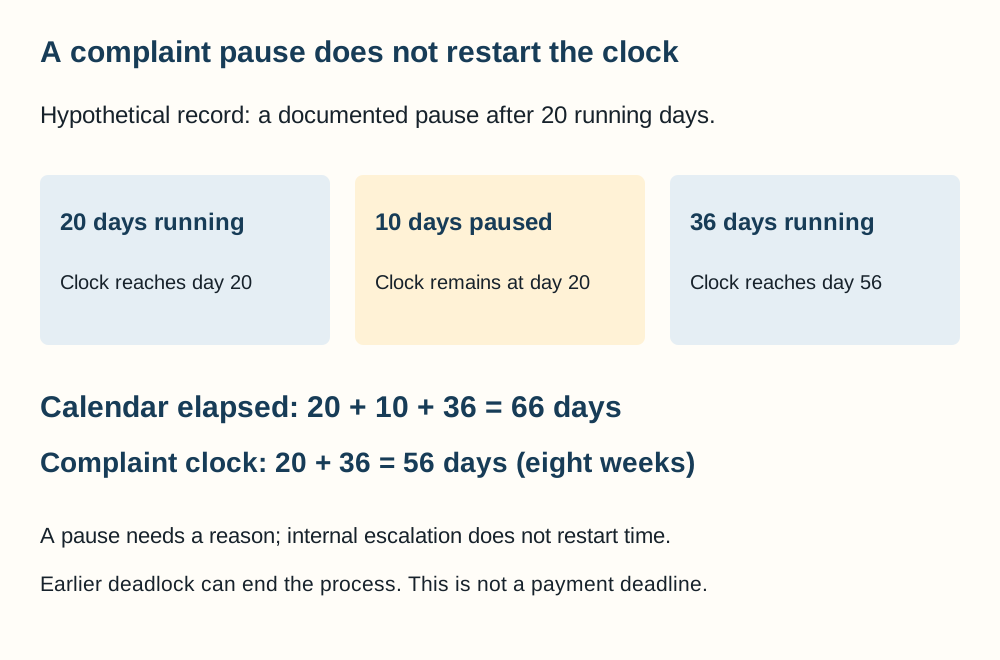
Here is a hypothetical calculation. Suppose 20 days have elapsed on the complaints clock, followed by a documented ten-day pause, after which the customer responds. The clock resumes at day 20.
Thirty-six further running days would bring it to 56 days, equivalent to eight weeks; total calendar time in that illustration is 66 days. No pause is assumed merely because an operator says its team is busy.
If a pause is disputed, ask for its reason, start, end and effect on the timetable. The arithmetic does not establish whether the pause was reasonable; it makes the operator's position reviewable.
Sources: Time limits and escalation of complaints.
The hypothetical clock calculation
| Event in the illustration | Effect on the complaints clock | Evidence |
|---|---|---|
| 20 days elapse on the complaints clock | Clock at day 20 | · Time limits and escalation of complaints |
| A documented ten-day pause | Clock stopped; no fresh eight-week allowance | · Time limits and escalation of complaints |
| The customer responds | The clock resumes at day 20 | · Time limits and escalation of complaints |
| Thirty-six further running days | Clock reaches 56 days, equivalent to eight weeks | · Time limits and escalation of complaints |
| Total calendar time in the illustration | 66 days | · Time limits and escalation of complaints |
The arithmetic does not establish whether the pause was reasonable; it makes the operator's position reviewable. If a pause is disputed, ask for its reason, start, end and effect on the timetable.
Keep document requests in the chronology
Identity or other information requests can sit alongside a withdrawal complaint. Record what was requested, when, through which official channel and when you responded. Save confirmation of submission where available.
The existence of a complaint does not establish that every further request is improper, or that the operator no longer needs information required by another legal obligation.
Licence condition 17.1.1 requires identity verification before a customer is allowed to gamble. It also says a withdrawal request must not trigger a demand for additional information that the licensee could reasonably have requested earlier. The condition expressly preserves requests required at that time by another legal obligation.
Both parts matter when you ask the operator to explain a late request.
A careful enquiry is: what information remains outstanding, why is it required now, and what previously supplied material has been considered? We cannot decide from a generic help page whether a particular request satisfies that condition.
Use the official account or complaints channel for sensitive documents. An editorial evidence worksheet needs a record of the request and response, not a public copy of a passport or full bank statement. Keep personal details out of any version you share outside the relevant process.
Sources: 17.1.1 Customer identity verification.
A careful enquiry about a late document request
We cannot decide from a generic help page whether a particular request satisfies condition 17.1.1.
Ticks are kept only in this browser and are never sent anywhere.
Prepare an evidence index rather than a wall of chat
Arrange the record so someone unfamiliar with the account can follow it. A practical index contains the original withdrawal request; the relevant terms or payment window; the complaint submission and acknowledgement; the operator's substantive responses; information requests and your replies; and any final response or ADR referral details. These are suggested organisational categories, not a provider's mandatory form.
Give each item a short label and date. In the chronology, refer to that label instead of pasting the same conversation repeatedly. Preserve the original wording in the underlying record, including any qualification attached to a timing estimate.
A screenshot cropped to show only “instant” may omit the condition that explains what the claim covered.
Separate agreed facts from disputed statements. “Both records show £200 requested” belongs in the first group if that is actually documented. “The operator says it was sent; the customer cannot identify the credit” belongs in the second.
That example is invented to illustrate the distinction, not a real missing withdrawal.
End with a short list of unresolved questions. The index should help an investigator find the relevant material quickly; the number of attachments is not a measure of the strength of a complaint.
Sources: How to complain.
The evidence index
Suggested organisational categories, not a provider's mandatory form. Give each item a short label and date, and refer to the label in the chronology.
Ticks are kept only in this browser and are never sent anywhere.
Use the designated ADR route at the appropriate stage
Where a dispute remains unresolved at the end of the business's process, the Commission's ADR guidance describes referral to an approved independent provider. The option must be available after eight weeks, taking account of applicable pauses, and may be available earlier at deadlock or a final position. The service must be free to the customer.
The guidance identifies disputes about gambling transactions, including account management or the ability to access funds, as matters ADR entities can consider. Use the provider identified for the dispute in the operator's procedure or final response and check that provider's submission requirements. Do not assume that every gambling business uses the same organisation.
An ADR referral is not a bank trace and does not establish an immediate payment deadline. Submit the chronology, the final position or relevant elapsed-time evidence, and the transaction documents needed to explain the disagreement. Keep copies of what you send and any follow-up requests.
This article does not predict acceptance, compensation or a decision. It also does not tell you to accept a settlement or waive any rights. Read the provider's current terms and seek independent advice if the legal consequences of a proposed resolution are unclear.
Sources: ADR requirements; How to complain.
Close the record with an outcome, or an explicit open question
When something changes, add the event rather than rewriting the earlier history. A payment appearing later, an amended decision and an unresolved deduction are distinct outcomes. Record the date, the evidence and which parts of the complaint remain open.
Do not mark an entire matter resolved merely because one requested explanation arrived.
Reporting a concern to the regulator and pursuing an individual funds dispute are also different tasks. The Commission's complaints hub directs people to the appropriate route and provides a separate way to report suspicious activity. A regulatory report is not evidence that your transaction has been adjudicated or that payment will follow.
The method here is documentary: establish the payment facts, preserve complaint receipt, account for responses and any stated pause, then use the relevant escalation route. We opened no account, requested no withdrawal and measured no operator's speed. A complete record can make an unresolved issue easier to examine without pretending to know the answer before the documents do.
Sources: Complaints; How to complain.
Ledger terms
- ADR
- Alternative dispute resolution: referral of an unresolved complaint to an approved independent provider, free to the customer.
- Deadlock
- The point at which the business states it can take the complaint no further, which can end its process before eight weeks.
- Final position
- The business's written last word on the complaint, with its referral information.
- Pause
- A documented stop on the complaints clock while the customer has not engaged; the clock resumes where it stopped.
- Payment trace
- A search for a released payment along its route, using the reference appropriate to that route.
- Settlement
- A proposed resolution of the dispute; this article does not tell you to accept one or waive any rights.
Questions answered
Why is my online casino withdrawal pending?
A pending label alone does not establish the cause. Ask the operator which stage the request has reached, what information or action is outstanding and which timescale applies to that stage.
Why have I been asked for ID before withdrawing?
The operator should explain the request. Commission condition 17.1.1 limits information demands that could reasonably have been made earlier, while allowing information required at that time by another legal obligation.
How do I complain about a gambling business?
Follow the business’s complaints policy, identify the disputed transaction, and retain the submission, acknowledgement and evidence. Make the requested outcome and unresolved issue explicit.
When can I take my complaint to an ADR provider?
Normally after completing the operator’s process, including at earlier deadlock or after eight weeks with any applicable clock pauses accounted for. Use the provider relevant to the dispute and check its requirements.
Does a pause give the operator a new eight weeks?
No. When the customer responds, the guidance says the clock should restart from the point where it stopped; this is a pause, not a fresh eight-week allowance.
Is an ADR referral the same as a bank trace?
No. An ADR referral is not a bank trace and does not establish an immediate payment deadline; submit the chronology, the final position or elapsed-time evidence and the transaction documents.
Payment sources
Continue reading
Withdrawal clocks: the operator's clock, the bank's clock, and what the terms say
A withdrawal has at least two clocks, and an identity check sits in front of both. Licence condition 17.1.1 and Pay.UK's own scheme page settle which clock may start when.
Read Withdrawal clocks: the operator's clock, the bank's clock, and what the terms say
Identity checks and withdrawals: the condition, the guidance and the scope
An identity check belongs at registration, not at the cashier. Licence condition 17.1.1 puts name, address and date of birth before any gambling, and says a withdrawal request must not trigger information that could reasonably have been asked for earlier.
Read Identity checks and withdrawals: the condition, the guidance and the scope
An identity check and a source-of-funds request answer different questions
A passport can establish identity without explaining a transfer. Sort a casino document request by the question it asks, then keep a receipt for the evidence supplied.
Read An identity check and a source-of-funds request answer different questions
How long do casino withdrawals take? What ten UK operators publish, and which clock each window measures
Ten UK operators’ published withdrawal windows by payment method, quoted from their help pages on 18 September 2026, with the operator’s processing clock separated from the bank’s.
Read How long do casino withdrawals take? What ten UK operators publish, and which clock each window measures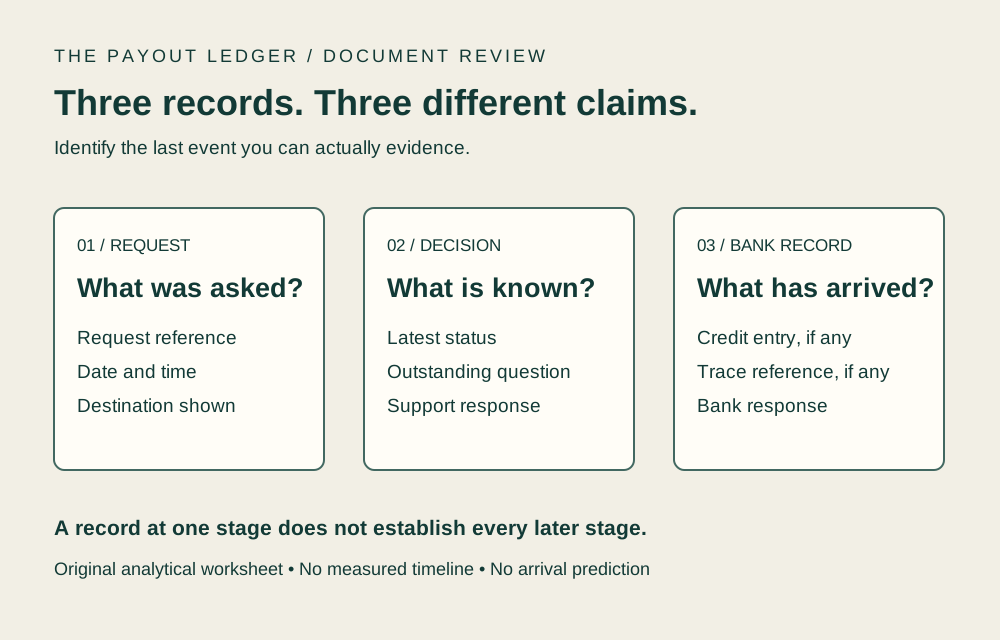
How do William Hill card withdrawals work? A document review
How to read William Hill’s card-withdrawal documents: payment routing, pending and approved requests, Visa Direct conditions and bank tracing.
Inspect How do William Hill card withdrawals work? A document review
Continue reading
Withdrawal clocks: the operator's clock, the bank's clock, and what the terms say
A withdrawal has at least two clocks, and an identity check sits in front of both. Licence condition 17.1.1 and Pay.UK's own scheme page settle which clock may start when.
Read Withdrawal clocks: the operator's clock, the bank's clock, and what the terms sayAn identity check and a source-of-funds request answer different questions
A passport can establish identity without explaining a transfer. Sort a casino document request by the question it asks, then keep a receipt for the evidence supplied.
Read An identity check and a source-of-funds request answer different questionsIdentity checks and withdrawals: the condition, the guidance and the scope
An identity check belongs at registration, not at the cashier. Licence condition 17.1.1 puts name, address and date of birth before any gambling, and says a withdrawal request must not trigger information that could reasonably have been asked for earlier.
Read Identity checks and withdrawals: the condition, the guidance and the scopeWithdrawal clocks: the operator's clock, the bank's clock, and what the terms say
Identity checks and withdrawals: the condition, the guidance and the scope
An identity check and a source-of-funds request answer different questions
How do William Hill card withdrawals work? A document review