Facts checked Article
Great Britain
Identity checks and withdrawals: the condition, the guidance and the scope
An identity check belongs at registration, not at the cashier. Licence condition 17.1.1 puts name, address and date of birth before any gambling, and says a withdrawal request must not trigger information that could reasonably have been asked for earlier.
Stage 1 — registration: the identity check the rules put first
An identity check belongs at the start of an account, not at the cashier window. That is the shape the rules give it, and it is the reason a check that arrives at withdrawal is worth writing down.
Licence condition 17.1.1, read on 22 September 2026, states that licensees must obtain and verify information in order to establish the identity of a customer before that customer is permitted to gamble. The information must include the customer's name, address and date of birth.
The Commission's player guidance puts the same rule in one line. All online gambling businesses must ask you to prove your age and identity before you gamble.
So the first ledger entry is the account opening. The first clock is the operator's, and it starts there.
Sources: Gambling Commission: licence condition 17.1.1; Gambling Commission: age and ID verification.
What the two documents establish
- Before any gambling
- Licensees must obtain and verify information to establish the identity of a customer before that customer is permitted to gamble, including name, address and date of birth.Gambling Commission: licence condition 17.1.1 · as checked on
- Before any deposit
- Licensees should inform customers what types of identity documents or other information may be needed, the circumstances in which they might be required, and the form and manner in which they should be provided.Gambling Commission: licence condition 17.1.1 · as checked on
- At withdrawal
- A request to withdraw must not result in a requirement for additional information as a condition of withdrawal if the licensee could reasonably have requested that information earlier.Gambling Commission: licence condition 17.1.1 · as checked on
- How long a check takes
- The Commission states that it cannot provide a timescale for identity checks, because the length of the process varies.Gambling Commission: age and ID verification · as checked on
Licence condition and player guidance, both read on 22 September 2026. Nothing here was measured by us and no operator's process was tested.
Why an identity check sits at the start
An identity check has a job, and that job explains its place in the order.
The guidance is short about it. All online gambling businesses must ask you to prove your age and identity before you gamble. Age comes first in that sentence for a reason.
A check done at the end cannot do that work. By then the account has been used, and the thing the rule protects has already happened.
So an identity check is a gate, not a receipt. It is there to open the account, not to release the money.
That is also why the condition adds a second duty. Licensees must take reasonable steps to ensure that the customer identity information they keep remains accurate. That duty runs for the life of the account, not for one moment at sign-up.
Sources: Gambling Commission: age and ID verification; Gambling Commission: licence condition 17.1.1.
Stage 2 — before the deposit: what the licensee should already have told you
The condition does not stop at obtaining the information. It also sets out what the customer should have been told before depositing.
A licensee should tell customers which identity documents it may need. It should also say when they might be required, and in what form.
The player guidance names the ordinary examples: passports, driving licences and household bills.
In practice that means a document list exists somewhere before any money moves. If it is not visible, it is worth asking for it at the point of deposit rather than at the point of withdrawal.
Sources: Gambling Commission: licence condition 17.1.1; Gambling Commission: age and ID verification.
Stage 3 — the withdrawal request: what cannot be asked for now
This is the entry that matters most to a reader with a pending balance.
The condition is direct here. A withdrawal request must not result in a requirement for extra information as a condition of withdrawal, where the licensee could reasonably have asked for it earlier.
The player guidance says the same thing in the second person. A gambling business cannot ask you to prove your age and identity as a condition of withdrawing your money if they could have asked you at an earlier point.
So the test is not whether the request is reasonable in itself. The test is when it could reasonably have been made.
Sources: Gambling Commission: licence condition 17.1.1; Gambling Commission: age and ID verification.
The withdrawal sentence, in the condition's own words
A request made by a customer to withdraw funds from their account must not result in a requirement for additional information to be supplied as a condition of withdrawal if the licensee could have reasonably requested that information earlier.
The ledger: where each request is supposed to sit
Requested — registration
Name, address and date of birth obtained and verified.
Typical Before the customer is permitted to gamble
Gambling Commission: licence condition 17.1.1 · as checked on
Told — before deposit
The customer is informed which documents may be needed, when, and in what form.
Typical Before any deposit is made
Gambling Commission: licence condition 17.1.1 · as checked on
Processed — the check itself
Verification may be instant where it is done electronically, or longer where documents are required.
Typical No timescale is publishedLongest seen The Commission states the length of the process varies
Gambling Commission: age and ID verification · as checked on
Requested again — at withdrawal
Only where the information could not reasonably have been requested earlier, or is needed to fulfil a legal obligation.
Typical Exception, not the rule
Gambling Commission: licence condition 17.1.1 · as checked on
Complaint — if the account is stuck
The gambling business handles the complaint through its own procedure first.
Typical 8 weeks before an ADR provider can be approached
Gambling Commission: ADR · as checked on
Stages as the licence condition and the player guidance set them out, read 22 September 2026. The timings are what those documents state, not anything we measured.
Stage 4 — the exception: information needed to meet a legal obligation
The guidance is explicit that the rule has an edge to it, and the edge is worth stating plainly.
It recognises that there may be occasions where a business can request information at withdrawal in order to fulfil legal obligations. It also states that where a business needs information for anti-money-laundering checks, it should ask promptly and not only when you want to withdraw your funds.
So a request at the cashier is not automatically improper. It may be a later obligation that could not have been anticipated at registration.
And a delayed withdrawal does not, by itself, establish which obligation applies. That is a question for the operator's published process, not for a reader's inference.
Stage 5 — the clock that is not published, and the one that is
A withdrawal usually has two clocks: the operator's processing time and the payment rail's transit time, where the rail is the bank or wallet network that carries the money. An identity check sits in front of both, and it has no published clock at all.
The Commission is direct about this. It states that it cannot provide a timescale for identity checks, as the length of the process varies, and notes that verification may be instant when done electronically or longer when documents are required.
One clock is published, and it is not the operator's. An ADR provider can be approached after 8 weeks.
That asymmetry is the whole practical lesson here. Record your own dates, because the only counted period starts when you complain.
Sources: Gambling Commission: age and ID verification; Gambling Commission: ADR.
Which request belongs at which stage
| What is requested | Stage the rules put it at | What the source states | Evidence |
|---|---|---|---|
| Name, address and date of birth | Before the customer is permitted to gamble | Licensees must obtain and verify information to establish identity before that customer is permitted to gamble. | · Gambling Commission: licence condition 17.1.1 |
| The list of documents that may be needed | Before any deposit | Licensees should inform customers what may be needed, in what circumstances, and in what form and manner. | · Gambling Commission: licence condition 17.1.1 |
| Age and identity as a condition of withdrawal | Not permitted where it could have been asked earlier | A business cannot ask you to prove age and identity as a condition of withdrawing if they could have asked you at an earlier point. | · Gambling Commission: age and ID verification |
| Information to fulfil a legal obligation | Permitted at withdrawal, as an exception | There may be occasions where a business can request information at that point in order to fulfil legal obligations. | · Gambling Commission: age and ID verification |
The middle column is the test to apply. It asks when a request could reasonably have been made, not whether the request itself is reasonable.
Stage 6 — what to do while the identity check is open
An identity check can be quick or slow, and the guidance says which is which. Verification may be instant where it is done electronically. It may take longer where documents are required.
Neither case comes with a published number. The Commission says it cannot provide a timescale, because the length of the process varies.
So write your own dates down. For this stage, the dates of each request and each reply are the only timeline that exists.
And leave the balance alone. A stalled identity check is a reason to use the route set out below. It is not a reason to put the money back into play.
If the business has told you what is outstanding, quote that wording back when you chase it. An identity check is easier to close when both sides are describing the same document.
What to record while the check is open
Keep the date a document was requested, the stated purpose, the official submission channel and the date you supplied it. Four lines, written down when they happen, are worth more than a recollection later.
Ask the business to clarify what remains outstanding and which part of its published process applies. Put the answer in the same record, with its date.
A factual record makes it easier to follow a complaint through the operator's procedure. It also makes the eight-week point easy to identify rather than estimate.
Use the operator's own channel for every exchange. A request answered outside the published route can be treated as not answered at all.
Sources: Gambling Commission: ADR.
The record to keep, one line at a time
Built from the licence condition and the complaints guidance read on 22 September 2026. Ticks stay in your browser and are not sent anywhere.
The condition expects the circumstances in which information might be required to have been explained before you deposited.
- The reference number for the withdrawal request itself.
Ticks are kept only in this browser and are never sent anywhere.
How to raise an identity check that has stalled
The route is fixed and it runs in one order. Taking it out of order is the usual reason a complaint is returned unexamined.
The steps below follow the Commission's published complaints route. The last one says what the route cannot decide.
Sources: Gambling Commission: ADR.
From a stalled check to an ADR provider
Five steps, in order, from the Commission's complaints guidance read 22 September 2026.
Ask which part of the published process applies
Get the business to name the stage the account is at and the information still outstanding. Record the date of the answer.
This is also the point to ask whether the request could have been made earlier, because that is the test the condition sets.
Complain through the business's own procedure
You cannot take a complaint to an ADR provider without first going through the gambling business's complaint process. Note the date it was received.
Count the eight weeks
The business has eight weeks to resolve the complaint from when it receives it. The clock is on the complaint, not on the identity check.
Approach an ADR provider
If you are not satisfied with the result, after 8 weeks you can take your complaint to an ADR provider, which is a free, independent service.
What the route cannot decide
An ADR provider will not accept complaints regarding a customer service issue, the refusal to accept a bet or your custom. It examines information from both sides; it does not set a timescale for a check.
When the window passes: the complaints route, in full
Gambling businesses must have arrangements for a customer to refer a dispute to an ADR provider where the business has not resolved it within eight weeks. The service is free to the customer.
An ADR provider examines information from both you and the gambling business. It does not accept complaints about a customer service issue, the refusal to accept a bet, or your custom.
That is the end of the published route, and it is worth knowing where it stops. Beyond it, the Commission regulates the business rather than arbitrating the individual dispute.
If a delayed withdrawal is tempting you to keep playing with the balance instead, that is a known pattern. GamCare is on 0808 8020 133, free, 24 hours.
Sources: Gambling Commission: ADR; Gambling Commission: self-exclusion.
Avoid a universal claim: what this entry does not cover
This is a summary of Great Britain-specific rules, not a judgement about an individual dispute or every jurisdiction. Northern Ireland is licensed differently, and an operator licensed elsewhere is outside the condition quoted here.
It is not a statement about any named business. No operator's process was tested, nothing was deposited, wagered or withdrawn, and no timing was measured.
It does not establish which obligation applies in any particular case. A delayed withdrawal does not, by itself, establish that either.
Read the current official guidance and the operator's own complaints process for the particular circumstances. The dates below say when each page was last read here.
Sources: Gambling Commission: age and ID verification.
Words used in this entry
- Licence condition 17.1.1
- A licence condition is a rule attached to an operating licence. Condition 17.1.1 is the one requiring customer identity verification before a customer is permitted to gamble.
- Identity check
- The obtaining and verifying of a customer's name, address and date of birth, which licence condition 17.1.1 requires before the customer is permitted to gamble.
- Source of funds
- A separate request about where money came from, made under anti-money-laundering obligations rather than under the identity condition.
- The rail
- The bank or wallet network that carries the payment once the operator releases it. It runs its own clock, separate from the operator's.
- ADR
- Alternative dispute resolution: a free, independent service that examines information from both the customer and the business after the eight weeks have passed.
- KYC
- An industry shorthand for know-your-customer work. The Commission's own documents describe it as customer identity verification, and that is the wording used here.
Pages read 22 September 2026
Four pages were opened on 22 September 2026, and every quoted line above traces to one of them.
Licence condition 17.1.1 supplied the identity requirement, the pre-deposit information duty, the withdrawal sentence and the duty to keep customer information accurate. The Commission's age and identity verification guidance supplied the player-facing wording, the document examples, the legal-obligation exception, the anti-money-laundering line and the statement that no timescale can be given.
The ADR guidance supplied the eight weeks, the free independent service and the complaints it will not accept. The page on self-exclusion, which is a formal agreement not to gamble, supplied the helpline number.
Two of those pages print their own last-updated dates: 13 April 2022 for the age and identity guidance, and 15 May 2026 for the ADR guidance. Both are recorded here, because a reader checking this entry later will want to know which version was read.
Nothing on this page was measured by us. We do not deposit, wager or withdraw. The wording above is the wording those pages carried on the day.
Sources: Gambling Commission: licence condition 17.1.1; Gambling Commission: age and ID verification; Gambling Commission: ADR; Gambling Commission: self-exclusion.
Questions answered
Can a casino ask for ID only when I withdraw?
Not where it could reasonably have asked earlier. Licence condition 17.1.1 states that a withdrawal request must not result in a requirement for additional information as a condition of withdrawal if the licensee could have reasonably requested that information earlier.
When is a check at withdrawal allowed?
Where the information is needed to fulfil a legal obligation. The Commission's guidance recognises such occasions, while adding that where a business needs information for anti-money-laundering checks it should ask promptly and not only when you want to withdraw.
How long should an identity check take?
The Gambling Commission states that it cannot provide a timescale, because the length of the process varies. It notes that verification may be instant where it is done electronically, or longer where documents are required.
What documents can be requested?
The guidance names passports, driving licences and household bills as examples. Licence condition 17.1.1 also expects the licensee to have told you before you deposited which documents may be needed and in what form.
What can I do if the check stalls?
Complain through the business's own procedure first, because an ADR provider cannot be approached before that. The business has eight weeks to resolve the complaint from when it receives it, after which you can take it to an ADR provider free of charge.
Payment sources
Continue reading

An identity check and a source-of-funds request answer different questions
A passport can establish identity without explaining a transfer. Sort a casino document request by the question it asks, then keep a receipt for the evidence supplied.
Read An identity check and a source-of-funds request answer different questions
Withdrawal clocks: the operator's clock, the bank's clock, and what the terms say
A withdrawal has at least two clocks, and an identity check sits in front of both. Licence condition 17.1.1 and Pay.UK's own scheme page settle which clock may start when.
Read Withdrawal clocks: the operator's clock, the bank's clock, and what the terms say
Build a complaint record for a delayed casino withdrawal
The withdrawal request and the complaint start different clocks. Keep the payment evidence, the operator’s response and the escalation record together without assuming what caused the delay.
Read Build a complaint record for a delayed casino withdrawal
How long do casino withdrawals take? What ten UK operators publish, and which clock each window measures
Ten UK operators’ published withdrawal windows by payment method, quoted from their help pages on 18 September 2026, with the operator’s processing clock separated from the bank’s.
Read How long do casino withdrawals take? What ten UK operators publish, and which clock each window measures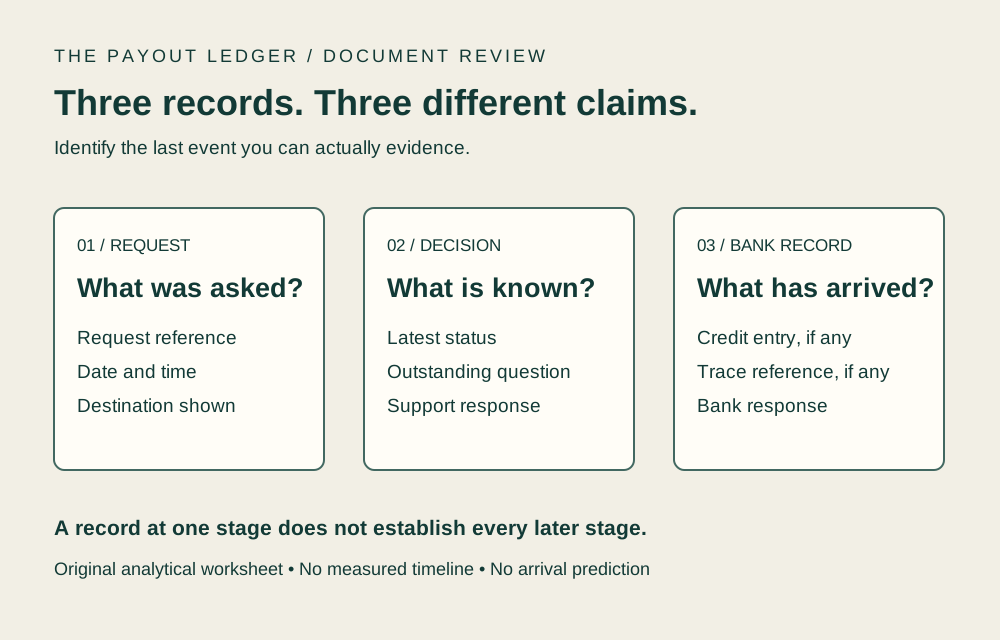
How do William Hill card withdrawals work? A document review
How to read William Hill’s card-withdrawal documents: payment routing, pending and approved requests, Visa Direct conditions and bank tracing.
Inspect How do William Hill card withdrawals work? A document review
Continue reading
An identity check and a source-of-funds request answer different questions
A passport can establish identity without explaining a transfer. Sort a casino document request by the question it asks, then keep a receipt for the evidence supplied.
Read An identity check and a source-of-funds request answer different questionsBuild a complaint record for a delayed casino withdrawal
The withdrawal request and the complaint start different clocks. Keep the payment evidence, the operator’s response and the escalation record together without assuming what caused the delay.
Read Build a complaint record for a delayed casino withdrawalWithdrawal clocks: the operator's clock, the bank's clock, and what the terms say
A withdrawal has at least two clocks, and an identity check sits in front of both. Licence condition 17.1.1 and Pay.UK's own scheme page settle which clock may start when.
Read Withdrawal clocks: the operator's clock, the bank's clock, and what the terms sayWithdrawal clocks: the operator's clock, the bank's clock, and what the terms say
Build a complaint record for a delayed casino withdrawal
An identity check and a source-of-funds request answer different questions
How do William Hill card withdrawals work? A document review